






09.24.2026

Samara Cohen, global head of market development at BlackRock, said the industry is on the precipice of a number of tokenization initiatives going into production in financial markets.
“I would say that up until now we have had way more PowerPoint than actual production,” she added.
Cohen spoke on a panel about tokenized finance at the Financial Markets Policy Conference 2026 hosted by the Georgetown Psaros Center for Financial Markets and Policy on 23 September 2026 at the Georgetown University campus in Washington D.C.
Frank La Salla, president, chief executive and director of the Depository Trust & Clearing Corporation (DTCC), said on the panel that a big change from a year ago is that the industry has separated cryptocurrency as an asset class from the underlying “powerful” blockchain technology that can help capital markets operate more efficiently. He explained that the U.S post-trade market infrastructure’s role is to prevent fragmentation and streamline the settlement system.

Frank La Salla, DTCC
“Our mandate is to be a conductor of traffic for the financial services industry and we will always look at new technology,” added La Salla. “When you break up asset pools you break up liquidity and price discovery, which is not good for end-investors.”
On 16 September 2026 Ondo Finance’s subsidiary Oasis Pro Markets, a U.S. registered broker-dealer and distributor of tokenized investment products become the first tokenization platform to become a member of DTCC’s Fund/SERV platform, a fund transaction processing and distribution network that currently serves over 85% of U.S. mutual fund activity. This paves the way for Ondo tokenized funds to be distributed across the traditional fund ecosystem, furthering DTCC’s strategy to support tokenized assets and facilitate interoperability across the traditional and digital finance ecosystems.
In July this year DTCC launched the initial phase of its tokenization service when it converted assets held at The Depository Trust Company into tokens that were then used in real production trades. The full DTCC Tokenization Service is set to launch in October 2026.
La Salla stressed that building a digital markets ecosystem is going to be a “very long” journey and will not happen overnight. In addition, different parts of the industry will use blockchain differently. For example, blockchain has the potential to enable intra-day repos and increase capital efficiency. One of the DTCC’s member firms did an analysis and said using intra-day repo could improve capital efficiency by 30%. He said: “That is massive.”
In equities, listed crypto exchange Bullish has announced an acquisition of transfer agency Equiniti in order to allow corporates to issue their shares natively onchain, while retaining all the traditional shareholder rights, such as the ability to vote. Transfer agents maintain the official record of ownership of an issuer’s securities and facilitate the issuance, cancellation, and transfer of securities. Through putting shares onchain issuers will know the identity of their shareholders, especially as they could also be potential customers, for example, companies could give shareholders a discount on products.

Tom Farley, Bullish
Tom Farley, chief executive of Bullish, stressed on the panel that the firm is only tokenizing shares with an issuer’s permission. He said: ”Issuers want to be in control of their equity. They put rules in place, write the smart contract and get lots of information about trading and who owns that token.”
He gave the example of recently receiving a call from a well-known gaming company, who had sent a cease and desist letter to a broker that had issued an allegedly tokenized version of its shares. However, they were not shares but a derivative giving economic exposure to the share price.
“If the broker went bankrupt, the investor would lose their money,” Farley added. “This is not tenable and not sustainable.”
This problem was highlighted recently when Adam Aron, chief executive of AMC, publicly objected to Robinhood tokenizing the cinema chain’s shares in a wrapper without permission. Aron argued that the broker set up a “fictitious synthetic equity market” that decouples stock token ownership from a company’s ability to control its own capital raising efforts, deprives token owners of shareholder rights such as being able to vote their stock and has created distrust amongst the public about financial markets in general.
Farley continued that traditional financial market infrastructures are not going to be left behind in the new digital asset world. One of his first jobs was overseeing the New York Board of Trade, which had not wanted to invest in electronic trading.
“They buried their heads in the sand and failed,” Farley added. “They were sold and the firm does not exist today.”
He was president of the New York Board of Trade from February 2007 after it was acquired by rival Intercontinental Exchange (ICE). He contrasted that failure with the current traditional market infrastructures that are investing in new technologies.
For example, on 10 September 2026 Nasdaq announced a $100m investment in Payward, the parent company of digital asset firm Kraken, which includes advancing development of the Nasdaq Equity Token (NET) framework.
On 23 September 2026 Blockchain.com, which provides crypto services for retail and institutional users, and the NYSE Group announced a distribution plan to provide Blockchain.com’s user base access to tokenized U.S. exchange-listed equities and exchange-traded funds (ETFs) on the NYSE’s previously announced digital alternative trading system (ATS), subject to any required regulatory approvals.
“The traditional finance guys are not going to be left behind,” added Farley. “They are going to compete, cooperate and collaborate alongside the new guys.”
Increasing distribution
BlackRock is one of the traditional financial firms that is investing in blockchain technology and tokenization. Cohen said tokenization and other new technologies can solve a fundamental problem of the lack of access to financial markets. She highlighted that not enough people participate in capital markets. Even in the U.S., which has the highest market participation, only about 62% of the population are investors.
Cohen compared tokenization to the advent of ETFs, which were born about 30 years ago, have more than $13 trillion in assets globally, and about 20% of equity markets. She added: “They have solved major problems for investors by creating access though giving a trusted way to reach markets because they are super convenient.”

Samara Cohen, BlackRock
She gave the example of BlackRock offering a bitcoin ETF in January 2024, which she said became the most successful ETF launch in history. Cohen said: “This was a huge vote of confidence in the U.S. ETF wrapper.”
In March of that year BlackRock also launched BUIDL, its first tokenized money market fund. There is now increased demand from crypto investors to make allocations to global equities and bonds, and who want the securities delivered onchain, according to Cohen.
On 24 September 2026 digital asset firm Ondo Finance announced that it was launching Ondo Intelligent Portfolios, a suite of professionally designed investment portfolios, each built into a single onchain token. The first three portfolios are based on portfolio strategies developed by BlackRock for Ondo, which the firm said marked the first time that exposure to such portfolio strategies have been made available to onchain investors.
Ondo said: “Because an Intelligent Portfolio is a token, it can collateralize a DeFi (decentralized finance) lending or perpetual futures position, power an earn product, or be held inside another Intelligent Portfolio. And of course users can assemble their own portfolio of Ondo Intelligent Portfolios as well.”
Cohen said that if tokenization fulfils its promise, more people will be participating in financial markets and they will have broader, more diversified portfolios.
A research paper from the Psaros Center for Financial Markets and Policy in September 2026 concluded that tokenization adds a new distribution and servicing layer to traditional funds without materially changing the underlying investment process. The study, What Does Tokenization Actually Intermediate?: Evidence from Real-World Asset Ledgers, analysed tokenized U.S. Treasury funds.
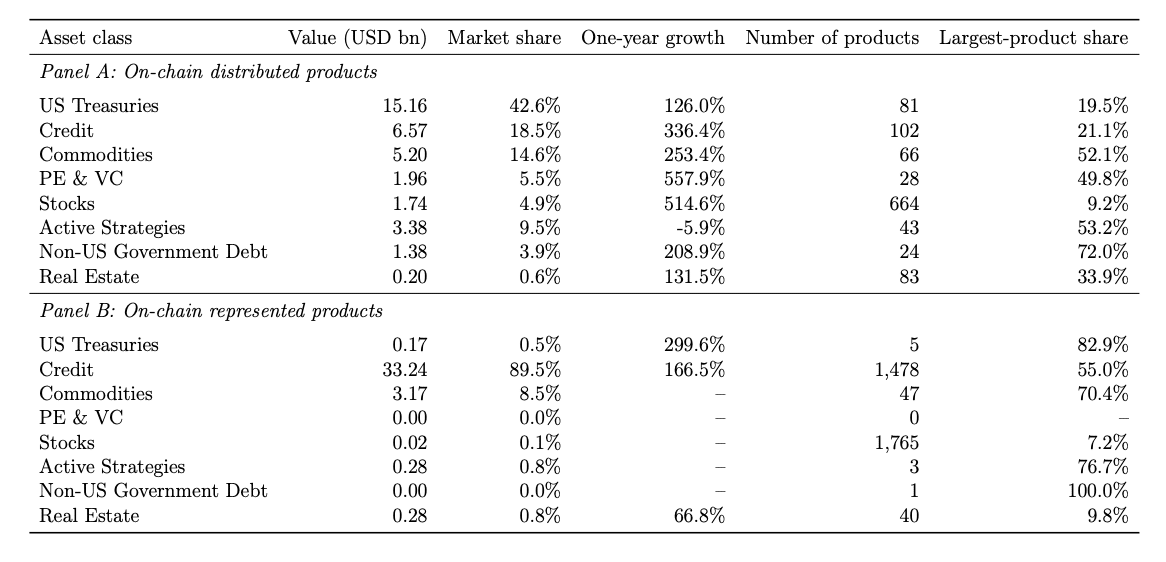
Source: What Does Tokenization Actually Intermediate?: Evidence from Real-World Asset Ledgers
“Tokenization has expanded from early experimentation to adoption by traditional asset managers, commercial banks, and other financial intermediaries, generating interest in its potential to broaden distribution, automate financial processes, and integrate conventional assets with blockchain-based markets,” said the paper. “Yet tokenized products generally continue to rely on established legal structures and traditional service providers.”
The study showed that tokenization primarily changes how fund shares are issued, recorded, transferred, and canceled but there is little evidence in the contract source code that token contracts execute purchases or sales of the underlying Treasury securities or provide custody of those assets.
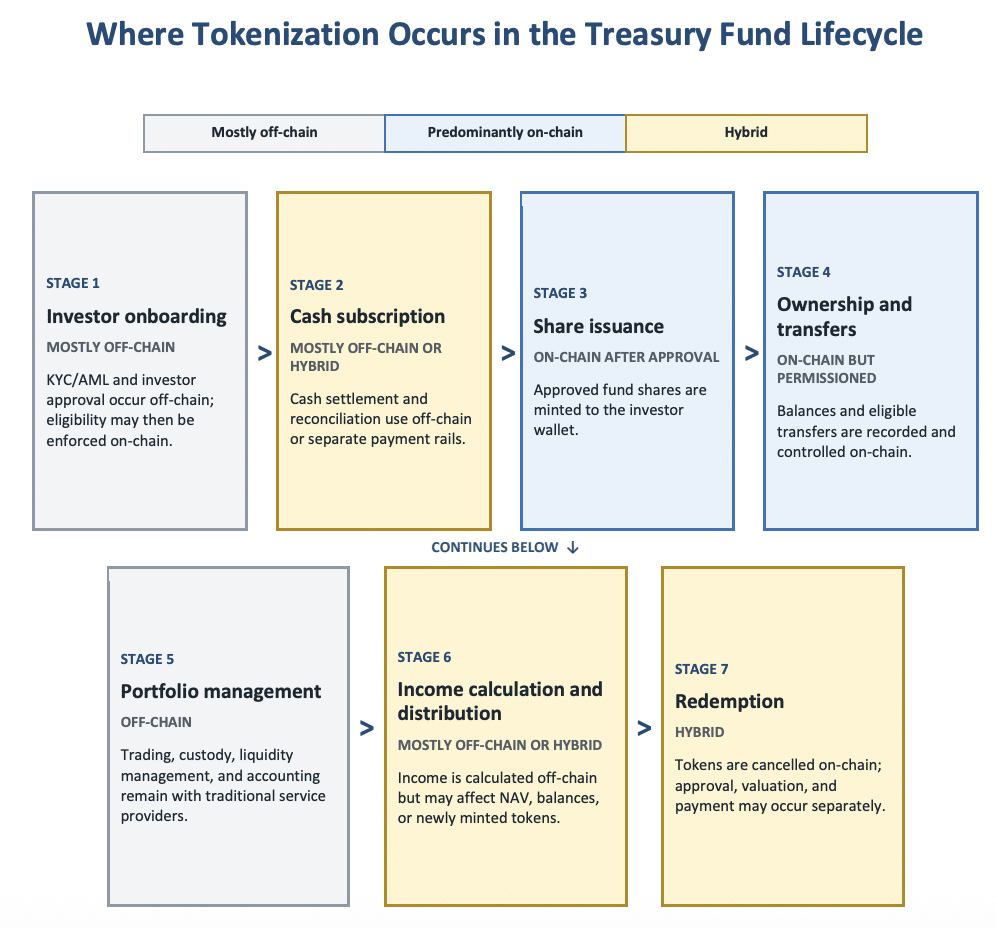
Source: What Does Tokenization Actually Intermediate?: Evidence from Real-World Asset Ledgers,
Portfolio selection, fund accounting, and most valuation functions also remain with traditional service providers, shares are issued or canceled onchain, while investor approval, cash transfer, valuation, reconciliation, and payment occur through separate systems. Therefore, the paper said tokenization changes the transfer agent and distribution portions of the lifecycle more clearly than the underlying investment process.
“Broader adoption may depend on whether the benefits of blockchain-based distribution and servicing justify the additional expenses of maintaining this infrastructure and the potential fragmentation across networks,” added the paper.
The machine-native economy
Our latest research paper explores the growing connection between AI and digital assets and explains why broad AI adoption may drive new demand, utility and applications across the digital asset economy. https://t.co/z5T88Orble pic.twitter.com/GMxQqTVmUN
— BlackRock (@BlackRock) September 22, 2026
BlackRock said in a research paper, The Machine-Native Economy, that the rise of digital assets represents a concurrent technology theme with AI, with particularly relevant implications for financial infrastructure.
“These themes have historically developed along largely parallel tracks, but they are beginning to converge as AI systems become more capable of interacting with financial and economic networks,” said BlackRock. “AI represents machine-native intelligence, while digital assets represent machine-native money.”
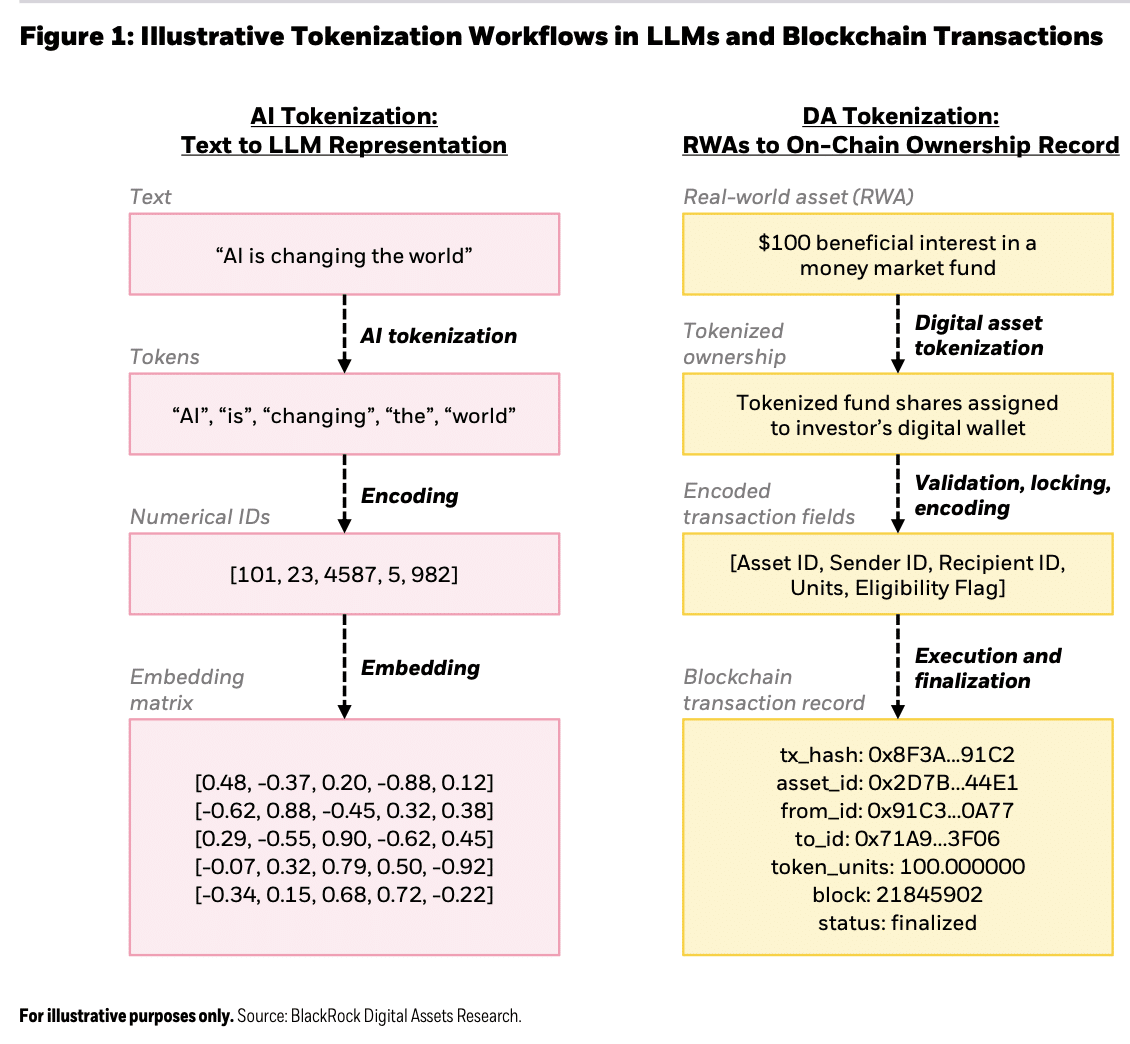
Source: BlackRock
The paper concluded that structured, machine-readable representations created through large language models and blockchain tokenization can give AI agents a more direct interface with programmable assets, while stablecoins may support high-frequency, low-value, always-on transactions.
“At the same time, standardized and liquid markets for compute claims could allow agents to source, optimize, finance, and pay for computing resources as inference demand expands,” said BlackRock.

NEWSLETTER SIGN UP
And receive exclusive articles on securities markets

🏆 The 2026 Global Markets Choice Awards are here! 🌍 Nominations are officially OPEN for the celebration of excellence in global capital markets trading & technology. Nominate below:
https://www.jotform.com/form/260086385121150

Delaware Life Insurance Company is becoming the first insurance carrier to offer an index that contains cryptocurrency, adding the BlackRock U.S. Equity Bitcoin Balanced Risk 12% Index to its fixed index annuity (FIA) portfolio.
As the digital assets industry pushes toward
Franklin Templeton is expanding its tokenized fund suite, signaling growing institutional demand for blockchain-based fund infrastructure and regulated investment products moving onchain. Read the full article below:
$50 billion in active ETF inflows helped fuel a record year for @BlackRock 's iShares business, as investors continue to lean into active strategies.
Shanny Basar
Senior writer
A Senior Writer at Markets Media who became a financial journalist in 2000 after working in banking for over a decade....
More about this authorRelated articles
-

Year-to-date net inflows of $432.4bn are the highest on record.
-
Fixed income is the largest asset class in global finance.
-

Erik Hirsch has been named executive co-chairman.
-

The asset manager has been in the process of adding more than 50 new client-facing roles.
-

Investors want FX execution to connect more seamlessly with portfolio and risk systems.